New music by me!
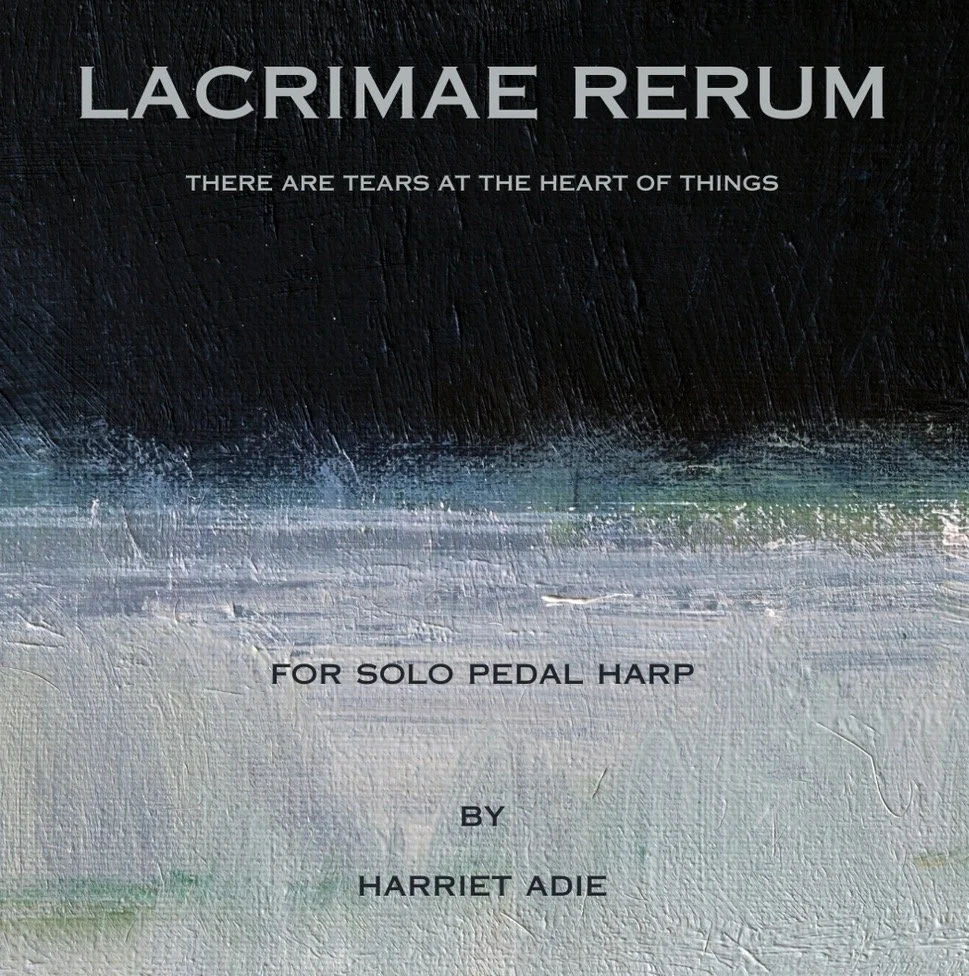
Approximately a year ago I was coaching on an NYO orchestral course when I found out that a friend and colleague who was due to have her baby had tragically lost her little girl Florence during labour. I cannot comprehend how this feels, a hole of grief that will never be filled, and somehow having to try to get back to living some sort of life with a part of one’s self missing. Having had four miscarriages, the news also brought back some of my own memories of loss - even with three living children, I think about the lost ones pretty much every day. All this sorrow and pain needed to go somewhere and I very much wanted to do something to honour Florence and help to keep her memory alive. After a couple of months, I felt that there was some music that wanted to come out and I spent January of 2026 stuck to the harp writing what became a substantial 7 minute solo for pedal harp: Lacrimae Rerum, dedicated to the memory of Florence Elizabeth Jageurs-Eve.
It is themed around love and despair and takes its name from from a passage of Book I of the Aeneid by the Roman poet Virgil (70-19BC), where the Trojan warrior Aeneas, worn down by war and much travel, has wandered into a Carthaginian temple dedicated to the goddess Juno. Here he gazes upon murals depicting the battles of the Trojan War and the deaths of his friends and compatriots. Upon witnessing these devastating sights anew, Aeneas is moved to tears and utters the words:
Sunt hic etiam sua praemia laudi;
Here, too, the praiseworthy has its rewards;
sunt lacrimae rerum et mentem mortalia tangunt.
there are tears for things and mortal things touch the mind.
Solve metus; feret haec aliquam tibi fama salutem.
Release your fear; this fame will bring you some safety.
‘...sunt lacrimae rerum et mentem mortalia tangunt.’ is one of the most quoted lines from the Aeneid, and has provided the inspiration for countless works of art, literature and music. There are many differing translations of this text as the Latin cannot easily be rendered directly into English, but the interpretation I am most drawn to is by the poet Seamus Heaney, who translated the first three words as ‘There are tears at the heart of things.’ To live truly is to experience the whole gamut of human emotion from joy and love through to anger and despair. To love fully, one must embrace grief at love’s cessation. Tears are at the heart of things; suffering is not incidental to life but an innate part of it.
Lacrimae Rerum is written for advanced pedal harp in a quasi-impressionistic (but modern) style and you can buy the music here.
Add To Cart